
Smart Home Pre-Wiring: What to Plan Before the Drywall Goes Up
Date: September 18, 2026
Read Time: 10 minutes
Key Takeaways
- Smart home pre-wiring gives homeowners more flexibility before contractors close the walls.
- By planning security, Wi-Fi, entertainment, automation, and other technology early, homeowners can avoid complicated retrofits later.
- Homeowners do not need to install every smart device during construction. Instead, they can prepare the home for future upgrades.
- Builders, electricians, and smart home professionals can work together to create a more organized technology plan.
- Ultimately, a well-planned new construction smart home starts with the infrastructure behind the walls.
Why Should You Plan Smart Home Technology Before the Drywall Goes Up?
When people build a new home, they usually spend a lot of time choosing the things they can see.
They compare flooring, cabinets, countertops, paint colors, and light fixtures. However, some of the most important decisions remain hidden behind the walls.
Once contractors install insulation and drywall, adding new wiring can become more difficult and disruptive. For example, installers may need to open finished walls, work around existing electrical systems, or compromise on equipment locations.
For that reason, homeowners should start planning smart home technology during construction rather than waiting until after they move in.
Smart home pre-wiring allows homeowners to prepare their new home for security, networking, entertainment, automation, and future technology while the framing remains open.
Best of all, you do not need to install every piece of technology immediately. Instead, you can create the infrastructure now and decide which upgrades make sense later.
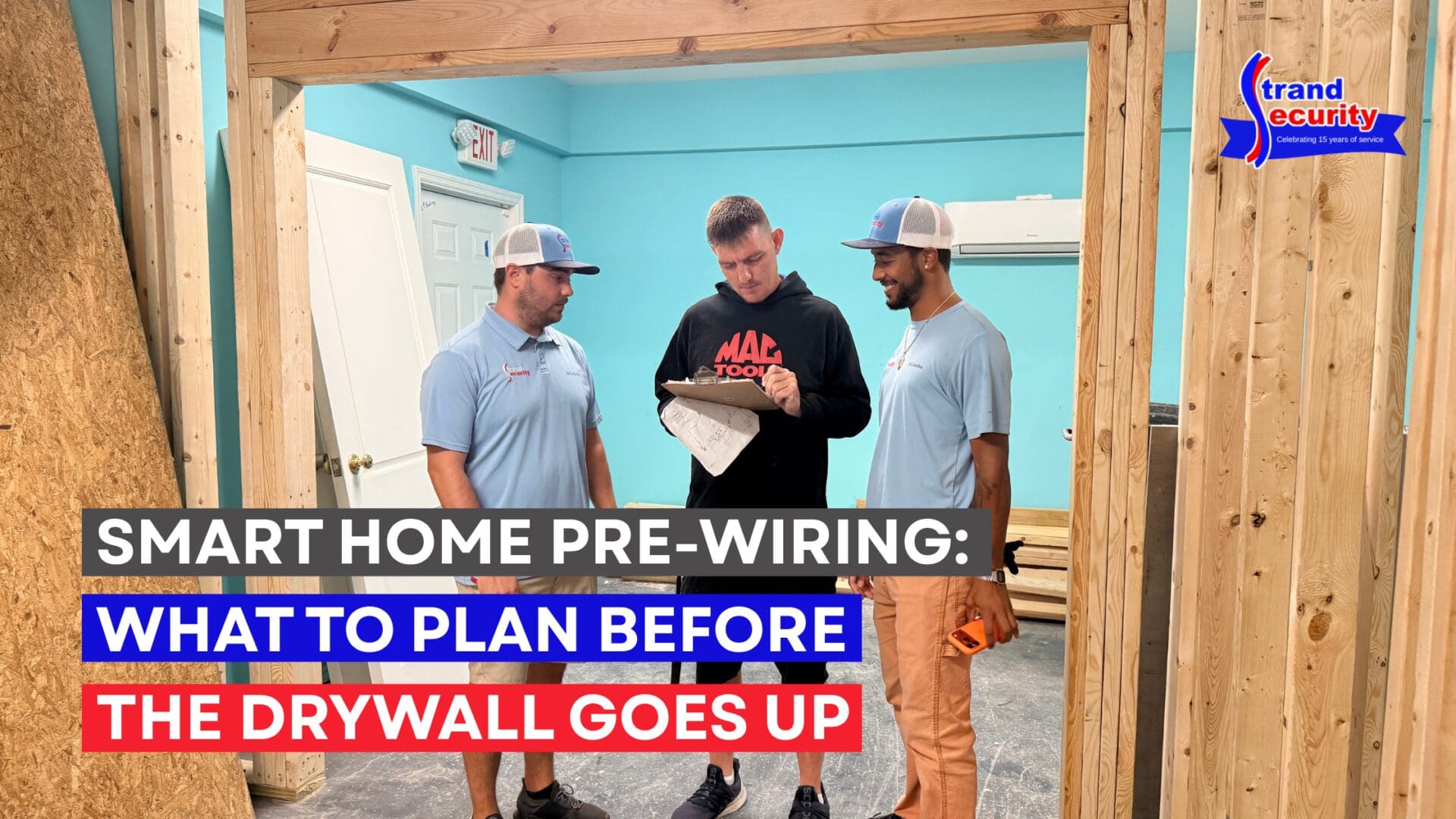
What Is Smart Home Pre-Wiring?
Smart home pre-wiring involves installing the wiring and infrastructure that can support technology throughout a home before contractors close the walls.
Depending on the home’s design and the homeowner’s plans, smart home wiring can support:
- Security systems
- Security cameras
- Video doorbells
- Whole-home Wi-Fi
- Wired network connections
- TVs
- Home theaters
- Surround sound
- Whole-home audio
- Outdoor entertainment
- Smart lighting
- Motorized shades
- Smart home automation
- Access control
Of course, every home needs a different technology plan.
For example, a young family building its first home may prioritize reliable Wi-Fi and security. Meanwhile, someone building a vacation property along the Grand Strand may focus on cameras, remote access, and outdoor entertainment.
Likewise, a custom home designed for entertaining may require more planning for audio, TVs, lighting, and automation.
The goal is not to fill every room with technology. Instead, the goal is to create the right foundation for how the homeowner plans to live in the space.
Why Is Smart Home Pre-Wiring Easier Before the Walls Go Up?
While the walls remain open, installers have direct access to the structure of the home. As a result, they can run wiring to important locations more easily and plan ahead for future technology.
For example, imagine that you want to mount a TV above the fireplace. By identifying that location during construction, you can plan for power, wiring, equipment placement, and the finished appearance before drywall limits your options.
The same approach can help with security cameras, Wi-Fi access points, ceiling speakers, outdoor entertainment, and other connected technology.
By planning smart home wiring early, homeowners can:
- Keep more wiring hidden.
- Choose equipment locations before construction limits their options.
- Coordinate technology with electrical and construction work.
- Create cleaner installations.
- Prepare for future upgrades.
- Avoid opening finished walls later.
As a result, you can build technology into the home instead of trying to add it after construction ends.
What Should You Pre-Wire in a New Smart Home?
Every home has different needs. However, several areas deserve consideration during the construction process.
Security and Video Surveillance
Start by looking at the home’s layout and identifying the areas that need protection.
During construction, you can plan for:
- Security cameras
- Video doorbells
- Alarm system equipment
- Door and window sensors
- Driveway coverage
- Gate access
- Detached garages or workshops
In addition, early planning allows you to consider where security equipment will live and how it will connect to the rest of the home.
Rather than treating security as an afterthought, homeowners can make it part of the overall design from the beginning.
How Should You Plan Wi-Fi and Networking in a New Home?
A modern smart home depends on a reliable network.
In fact, your home network acts as the foundation for many of the connected devices you use every day. Security cameras, smart TVs, video doorbells, voice assistants, thermostats, and other smart devices all rely on that connection. The Federal Trade Commission also recommends taking steps to secure both your home network and connected devices, including changing default passwords, using available security features, and keeping software up to date.
Source: Federal Trade Commission
Security cameras, smart TVs, streaming devices, automation systems, video doorbells, phones, computers, and other connected devices all rely on strong connectivity.
However, placing one Wi-Fi router somewhere in the house does not always provide reliable coverage everywhere.
The size of the home, construction materials, layout, and number of connected devices can all affect performance. Therefore, homeowners should think about networking before construction ends.
During the planning process, consider:
- Strategically placed Wi-Fi access points
- Wired network connections
- Home offices
- Entertainment areas
- Security equipment
- Outdoor spaces
- A central location for networking equipment
With the right infrastructure in place, your network can better support the technology you use today and the devices you may add later.
How Can Smart Home Pre-Wiring Improve TVs and Home Entertainment?
Home entertainment offers another excellent reason to plan ahead.
First, think about where you want to watch TV. Next, consider where the equipment, speakers, and wiring need to go.
When you answer those questions before construction ends, you can create a cleaner and more intentional installation.
A smart home pre-wiring plan may include preparation for:
- Wall-mounted TVs
- Hidden wiring
- Surround sound
- Ceiling speakers
- Whole-home audio
- Dedicated home theaters
- Outdoor TVs
- Patio speakers
- Outdoor kitchens and entertainment areas
Importantly, you do not need a dedicated home theater to benefit from early planning.
Even a simple living room TV installation can look cleaner and work better when the builder and technology professionals plan the location before drywall goes up.
Can You Plan for Smart Lighting and Motorized Shades During Construction?
Yes. In fact, construction provides an excellent opportunity to think about how lighting and shades will work throughout the home.
Smart lighting can simplify control, create customized scenes, and help homeowners manage lighting in different areas. Similarly, motorized shades can help control sunlight, privacy, and screen glare.
During the planning process, consider:
- Lighting control locations
- Keypads
- Window treatments
- Power requirements
- Control systems
- Integration with other smart home technology
For example, a homeowner might eventually create a Movie Night scene that lowers the shades, dims the lights, and turns on the entertainment system.
Alternatively, a Goodnight scene could turn off selected lights, close the shades, and activate preferred security settings.
Ultimately, the right technology should make everyday life easier rather than adding more steps.
Why Should You Plan Outdoor Smart Home Technology Early?
Outdoor spaces have become an extension of the home.
Throughout the Grand Strand, homeowners use patios, porches, outdoor kitchens, and backyards for much more than occasional entertaining. They host cookouts, watch football, spend evenings outside, and gather with family and friends.
Therefore, outdoor technology deserves a place in the construction plan.
Homeowners may want to prepare for:
- Outdoor TVs
- Weather-appropriate audio
- Security cameras
- Smart lighting
- Wi-Fi coverage
- Outdoor access points
- Automated entertainment controls
You may not want to install every piece of equipment immediately. Nevertheless, preparing the infrastructure during construction gives you more flexibility later.
That can be particularly valuable when an outdoor kitchen, patio, pool area, or entertainment space plays an important role in how you plan to use your home.
Do You Need to Install Everything During Construction?
No. In fact, this flexibility represents one of the biggest advantages of smart home pre-wiring.
You can prepare your home today and choose the technology later.
For example, you may want a professionally monitored security system and reliable Wi-Fi when you move in. However, you may not feel ready to invest in whole-home audio or a dedicated theater.
That is perfectly fine.
Instead, you can install the infrastructure during construction and add compatible technology when it fits your lifestyle and budget.
Five years from now, you may decide to add:
- Whole-home audio
- Additional security cameras
- Motorized shades
- A home theater
- Outdoor entertainment
- Expanded smart home automation
Because you planned ahead, those upgrades may require less disruption than trying to retrofit a finished home without the necessary infrastructure.
In other words, smart home pre-wiring creates options.
You do not need to predict every piece of technology you will ever own. Instead, you simply give your home a stronger foundation for the future.
How Does Early Smart Home Planning Help Builders and Contractors?
Builders and contractors already coordinate dozens of moving parts during construction.
They manage electrical work, plumbing, HVAC, flooring, cabinetry, lighting, and countless other details. Therefore, technology should enter the conversation early enough to avoid last-minute changes.
Builders do not need to become experts in every security, networking, or automation system. Instead, they can work with a technology partner who understands how to plan and install the right infrastructure.
Early coordination can help everyone understand:
- Where technology equipment will go
- Where wiring needs to run
- Where homeowners plan to mount TVs
- Where security cameras should provide coverage
- Where speakers may go
- Where networking equipment will live
- Which areas may need stronger Wi-Fi
- What technology homeowners may want to add later
As a result, the entire construction team can coordinate more effectively before contractors close the walls.
That approach can reduce last-minute changes and help create a cleaner finished result.
How Do You Build a Smart Home That Can Grow With You?
Technology changes, and your needs can change too.
For that reason, the smart home you build today should give you room to adapt in the future.
A thoughtful plan focuses on the infrastructure behind the walls as well as the devices you install today.
Instead of asking:
What gadgets do I want right now?
Consider asking:
How do I want my home to work in five or ten years?
Over time, you may want more cameras. A spare bedroom could become a home office. Your family may use certain rooms differently, or a patio may eventually become an outdoor entertainment space.
Because life changes, your home should have the flexibility to change with you.
Smart home pre-wiring can help create that flexibility from the beginning.
Smart Home Technology Works Best When You Start With a Plan
The best smart homes do not necessarily have the most devices.
Instead, they have the best plan.
A thoughtful smart home design considers how the homeowner uses each room, where technology makes sense, and how different systems can work together.
For example, security does not need to operate separately from networking. Entertainment does not need to require a pile of remotes. Likewise, lighting and shades can work alongside other connected technology.
Most importantly, homeowners can add new technology as their needs change.
When you start planning before construction ends, you have more opportunities to make those decisions intentionally.
Build the Technology Into Your Home—Not Onto It Later
If you are building a new home, now is the time to think about more than paint colors and countertops.
Before the drywall goes up, consider how you want your home to protect, connect, entertain, and adapt to your life.
At Strand Security, we work with homeowners, builders, contractors, and other construction professionals throughout Myrtle Beach, Horry County, Georgetown County, and the Grand Strand to plan security and smart home technology for new construction projects.
Whether you want to prepare your home for security cameras, professionally monitored alarms, reliable Wi-Fi, whole-home audio, TVs, smart lighting, motorized shades, or future automation, early planning can make a major difference.
You do not need to install everything today. However, while the walls are open, you have an opportunity to prepare for tomorrow.

Frequently Asked Questions About Smart Home Pre-Wiring
What is smart home pre-wiring?
Smart home pre-wiring involves installing wiring and infrastructure during construction to support security, networking, entertainment, automation, and other connected technology.
When should I plan smart home technology for a new home?
Start planning as early as possible during construction. Ideally, you should coordinate with your builder and smart home professional before contractors close the walls.
What should I pre-wire in a new home?
Your plan may include security cameras, alarm systems, networking, Wi-Fi access points, TVs, speakers, home theater equipment, outdoor entertainment, smart lighting, and motorized shades. Your home’s design and lifestyle should guide those decisions.
Can I add smart home technology later?
Yes. You can add many smart home devices after construction. However, when you plan the infrastructure before drywall goes up, you can make some future upgrades easier and less disruptive.
Do I need smart home pre-wiring if I only want a security system?
Pre-wiring can still help if you plan to install security cameras, sensors, networking equipment, or other connected devices. A security professional can help you decide what makes sense for your home.
Can builders work directly with Strand Security?
Yes. Strand Security can work with builders, contractors, and homeowners to plan security, smart home technology, networking, entertainment, and other low-voltage infrastructure during new construction.
Is smart home pre-wiring only for luxury homes?
No. Your budget, home, and goals determine the right plan. You can prepare a home for basic security and networking or create infrastructure for a more extensive smart home system. Either way, planning early gives you more flexibility.
